
Our Location
304 North Cardinal St.
Dorchester Center, MA 02124

Six practical home decor arrangements using wooden trays, ceramic vases, sculptures, macrame wall decor, and a plant stand, with measurements and a buying checklist.
You do not need a room full of matching accessories to make a space feel finished. Start with one surface you use every day, give it a clear purpose, and choose a few objects that work together. A wooden tray can organize the coffee table, a ceramic vase can break up a row of books, and a woven wall hanging can add texture above a console.
This room-by-room guide brings together home decor ideas for coffee tables, shelves, and entryways. The arrangements use pieces from the Cozy Walls Home collection alongside books and personal objects you may already own. You can try one arrangement at a time; there is no need to buy everything shown or mentioned.
Choose one focal piece, give it a quieter companion, and leave useful space around both. Measure the complete arrangement before ordering. A good display should still let you put down a drink, take out a book, or find your keys.
Look at what the space needs to do. A coffee table is a working surface, a bookshelf needs to keep books accessible, and an entryway is a place where things arrive and leave. Decorating becomes easier when you reserve that useful space first.
Clear the surface, put back the items you use daily, and see what room remains. Then decide whether you need height, a different texture, or one distinct shape. This is more helpful than buying several attractive objects and trying to make them fit afterward.
| Space | Start with | Keep available |
|---|---|---|
| Coffee table | A compact tray and one small vase | Room for drinks and a clear seated view |
| Bookshelf | A decorative vase beside a short run of books | Access to books and clearance above the vase |
| Entryway | A tray for everyday items and one wall accent | A landing spot for keys and mail |
| Console or sideboard | A vase pair or one sculpture | Space around the silhouette |
| Plant corner | A stand sized to the available footprint | Walking space, suitable light, and access for care |
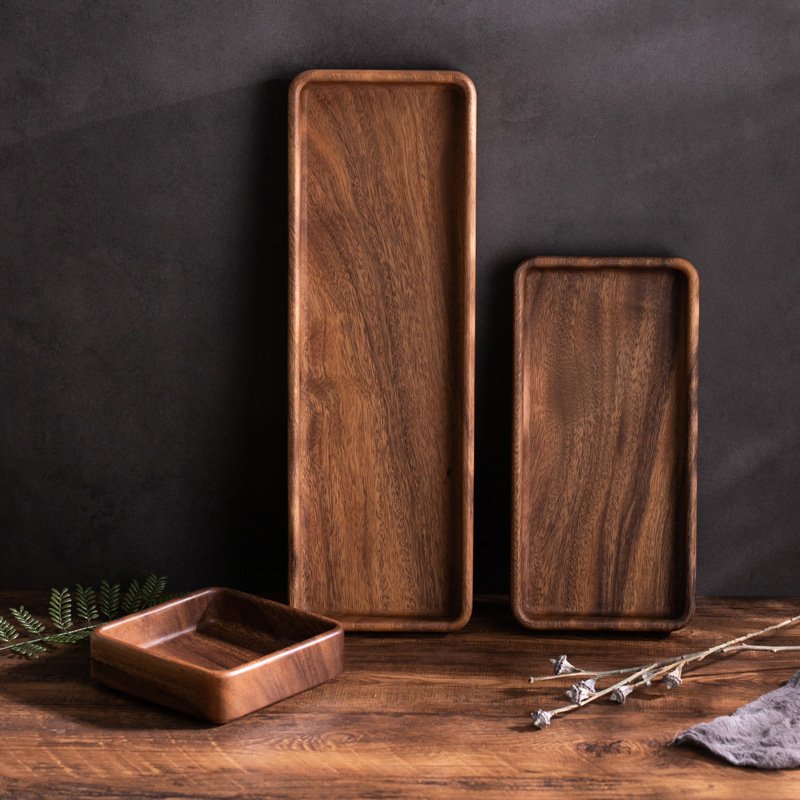
A tray gives a small collection a boundary. Instead of spreading accessories across the whole table, keep them in one zone that is easy to move when the table is needed. Begin with the tray alone, then add a vase and check whether anything else is necessary.
The wooden storage tray comes in several shapes and sizes. One listed rectangular option measures approximately 11.0 by 5.5 by 1.3 inches (28 × 14 × 3.3 cm). That is the tray’s overall size, not a guaranteed measurement of the usable interior. Compare the base of your vase with the interior space and check the exact option before ordering.
For a compact accent, consider the small ribbed ceramic bud vase, approximately 4.7 inches tall (12 cm). Its opening is only about 0.6 inches (1.5 cm), so a few slim dried or artificial stems make more sense than a broad bouquet. Test the combination with the vase empty first.
Try this arrangement: a rectangular tray, one bud vase toward an end, and open space beside it. If you want to include books, set them alongside the tray rather than automatically stacking everything inside it. Keep the finished display low enough for people seated across the table to see comfortably.
Common mistake: choosing a tray that fills most of a small table. A grouping can look tidy while still taking up too much space. Check whether you can set down a cup without moving the display.
A bookshelf arrangement works best when the books remain part of the composition. Start with a short run of upright books, add one decorative object beside them, and leave a visible gap. Avoid filling every available opening simply because it is empty.
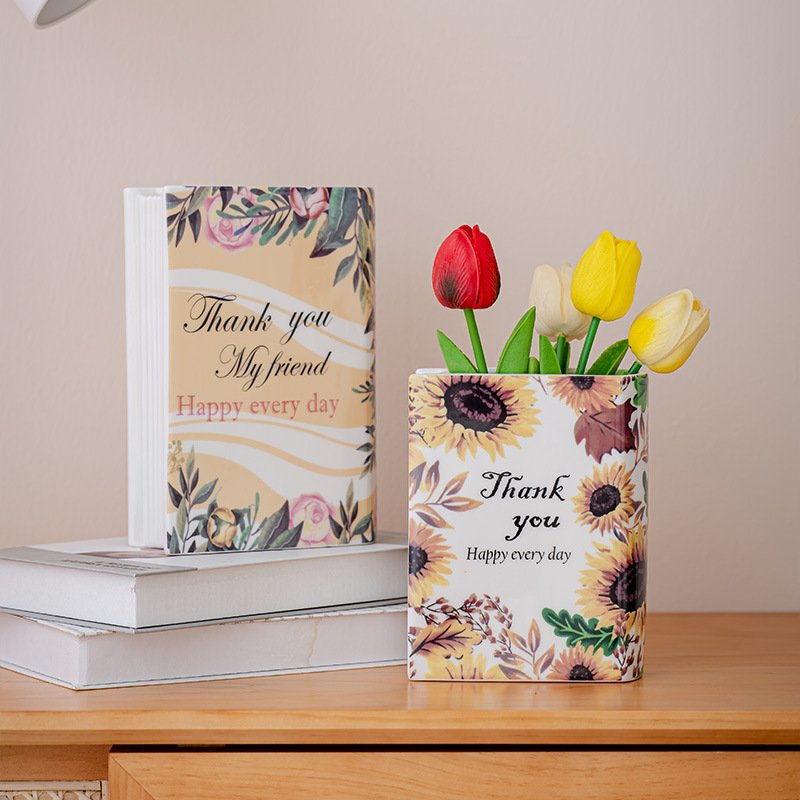
The book-shaped ceramic vase offers a different silhouette from a round vessel. Its printed, book-inspired design can sit beside actual books as a visual contrast. The small designs are listed at approximately 13 × 6 × 16.5 cm (length × depth × height); the large floral design is approximately 13.5 × 6.8 × 20.5 cm. Check the selected design and leave clearance for any stems; opening dimensions are not supplied.
Position the vase where it will not be knocked when you pull out a book. Keep its entire base supported. If there is little clearance above it, use it without stems or choose another shelf rather than squeezing a tall arrangement under the next board.
Try this arrangement: upright books on one side, the decorative vase on the other, and a gap between the group and the shelf edge. On a neighboring shelf, use a horizontal stack or a personal photograph so the shelves relate without repeating exactly.
For more ways to position vessels, see our ceramic vase styling guide. Use that guide for the vase itself and this arrangement for its relationship with the surrounding books.
Detailed shapes do not need many neighboring accessories. If a sideboard already holds a lamp, framed photograph, or everyday storage, choose a sculpture as the one additional focal point and remove anything that competes with it.
The loving couple resin sculpture can provide that figurative shape. Resin is a different material from ceramic, so choose it for its form and appearance rather than assuming it has the same finish or care requirements as a vase.
Place it against a backdrop that makes the outline readable. A pale piece may show more clearly against wood or a darker wall. If you use a low book stack nearby, leave a gap so the forms do not merge into one crowded group.
Try this arrangement: one sculpture, a nearby personal photograph, and an otherwise clear section of sideboard. Look at the display from the doorway as well as close up. If the silhouette disappears, change its position before adding more objects.
An entryway needs a place for daily essentials. Choose a tray for small items, then keep the rest of the console simple. The wall above it can add texture without using more tabletop space.
Our cotton macrame wall hanging measures approximately 15.7 by 27.6 inches (40 × 70 cm). Make a paper outline of that footprint and compare it with the console and nearby doorways. A product that looks substantial in a close-up photograph can feel different on a broad wall.
Let the woven pattern provide the detail. A plain tray or simple ceramic form below it can repeat a tone without competing with the knots and fringe. Keep loose fringe clear of door handles, heat sources, and places where it could be pulled.
Try this arrangement: one woven hanging above a console, a tray for keys on one side, and clear space where you normally put down your bag. Follow mounting instructions and use fixings appropriate to the actual wall and product weight.
Read our macrame wall hanging guide for more on backdrop, scale, and placement.
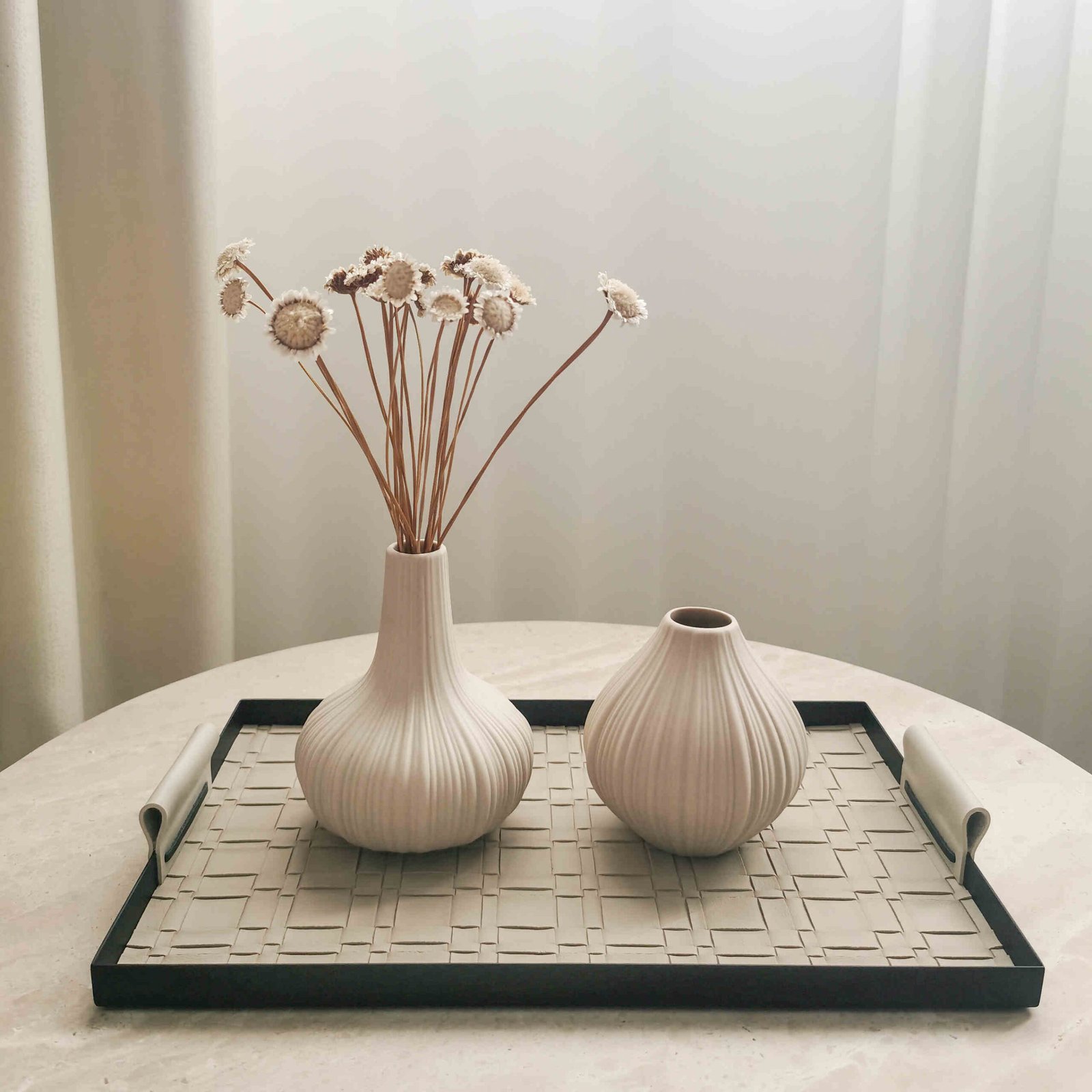
A pair of related shapes can give a console a connection without requiring a full matching collection. Position the taller or visually larger form first, then move its companion slightly forward or to one side. Leave a gap that allows both outlines to remain visible.
The beige ceramic vase set is an option for a soft, neutral arrangement. You can display the pair together or separate them across nearby surfaces. Start without stems so you can judge the shapes; add dried or artificial stems only if the extra height helps.
If you prefer stronger contrast, the black and white ceramic body vase set provides related silhouettes in two colors. Repeat a dark or light tone already in the room through a frame or textile, rather than buying more decor solely to match the vases.
Common mistake: using a photograph to estimate scale. For either arrangement, compare the product dimensions with the available console depth and the space below any artwork. Our vase size guide explains which measurements to take.
A multi-shelf stand can bring plants into one display, but it needs enough room around it. Measure the floor area, the nearby walkway, and the available height before deciding that a stand will suit a corner.
The half-moon plant stand with 12 shelves is approximately 55.1 inches wide, 11.8 inches deep, and 69.7 inches high (140 × 30 × 177 cm). It is a substantial display, not a tiny tabletop accessory. Compare that full width with your room before choosing it.
Arrange plants according to their actual light and care needs. Leave room to lift out pots for watering and check the stand’s assembly and load guidance rather than assuming that every shelf can hold a large, heavy planter. Protect the surrounding floor and follow the product’s care instructions.
Try this arrangement: a stand in a measured display zone, with enough separation between plants for leaves and access. Leave neighboring furniture quieter so the plant collection becomes the focal point.
No. A repeated tone, shape, or material can connect an arrangement without making every piece identical. For example, a wood tray and beige ceramics can relate through their warm appearance, while a photograph adds something personal. See our neutral decor and texture guide for ways to make those connections.
There is no universal number. Start with one focal object and one useful grouping, then check the remaining space. A small table may need only a vase and a tray; adding a third object is optional, not a decorating requirement.
Only when the specific product is confirmed as suitable for holding water. The word “ceramic” alone does not establish that. For decorative vessels with unverified water resistance, use dried or artificial stems, or display the shape on its own.
You can start with one piece and see how it works in your room. Live with the arrangement, check it in daylight and evening light, and add another object only when it improves the composition or serves a purpose.
Choose one arrangement from this guide, measure the space, and try it with objects you already own. If something is missing, select a piece for that specific role rather than filling every surface.
Browse the home decor collection to compare options, or ask us about an unclear measurement before ordering. The goal is a space that looks considered and remains comfortable to use.
